


Training to failure: what it actually means
Muscle failure is the point in a set where you can no longer complete a full rep despite giving everything you have. It's not "this burns", and it's not "this feels heavy". It's the bar stopping halfway up while you're still pushing.
That distinction changes everything. A set taken to failure is a set your muscle ends, not your head. Most lifters actually stop 3 to 4 reps short of that point: the research on how people rate their own effort shows this gap again and again, in beginners and intermediates alike.
Technical failure vs. absolute failure
Two different things hide behind the same word. Technical failure is when form breaks down: back rounding on the deadlift, elbows flaring, legs swinging on rows. Absolute failure is when the muscle can't move the load another inch.
- Technical failure: another rep is still possible, but it turns ugly
- Absolute failure: the bar stalls, no rep is coming
- Neural failure: coordination goes before the muscle does, typical of heavy loads
Nine times out of ten, technical failure is the right target. Push past it and the exercise becomes something else, shifting the work onto other muscles.
Where failure comes from: muscle or nervous system
A long set with a moderate load mostly drains the fibres themselves: energy substrates, metabolite build-up, a drop in force output from the working muscle. That's muscle failure in the strict sense.
A short, very heavy set fatigues the nervous system first. The muscle still has something left, but the command signal doesn't follow. That's why a 3-rep max squat leaves you foggy for an hour, while a set of 15 lateral raises burns without costing you much of anything.
On big compound lifts, it's almost never the muscle that gives out first. It's your ability to hold position.
Should you go to failure on every set?
No. Taking every set of a session to failure costs a lot in fatigue and returns very little extra hypertrophy. Recent research converges on the same answer: at equal volume, stopping 1 to 3 reps short gives comparable muscle gains, with far faster recovery.
The logic is simple. Total volume — the number of reps performed with a heavy enough load — is still the main driver of progress. If hitting failure on your first set costs you 5 reps across the next two, you've traded intensity for lost volume.
| Approach | Sets to failure | Recovery |
|---|---|---|
| Beginner | None | 24h |
| Muscle gain | 1 in 3 | 48h |
| Strength | Rarely | 48 to 72h |
| Bodyweight | Often | 24 to 48h |
When going to failure makes sense
Some situations justify running a set all the way out. What they have in common: low injury risk, and real doubt about how hard you're actually working.
Isolation exercises
Curls, extensions, leg curls, raises: the load is light, the path is guided, and dropping the weight puts nobody in danger. These are the ideal exercises to end a session with a set or two taken to failure.
Bodyweight training
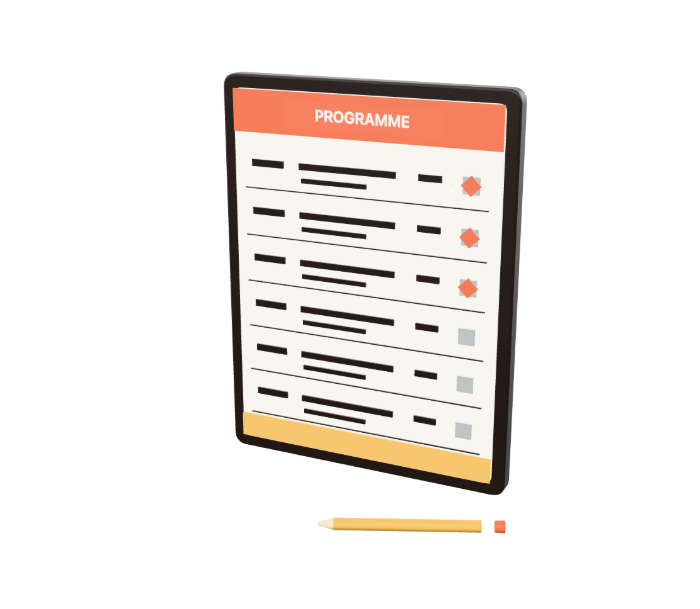
Push-ups, pull-ups, dips: with no equipment, you can't just add load. Intensity then comes from the number of reps, and reaching failure becomes your main lever to keep building muscle. Our ready-to-run training programs are built on exactly that principle for equipment-free sessions.
The last set of an exercise
One final all-out set gives you a reference point. It tells you where you really stand and recalibrates how you judge effort for the weeks that follow.
When you're better off stopping short
There are situations where chasing failure makes your training worse, not better.
- On heavy lifts: squat, deadlift, bench press without a spotter
- Early in a session, with four exercises still to go
- For beginners, whose technique falls apart before their muscles tire
- During a strength block, where execution quality comes first
- When you're short on sleep or under heavy stress
Your joints and tendons recover more slowly than your muscles. Repeating all-out sets with heavy loads, week after week, eventually shows up in your elbows and shoulders.
Programming: how much failure across the week
A simple, sturdy rule: save failure for the last set of your isolation exercises, and keep 2 reps in reserve everywhere else. On a six-exercise session, that's two or three all-out sets, not fifteen.
The tricky part is tracking it. With nothing written down, there's no way to tell whether you're progressing or just piling up fatigue. Logging load, reps and perceived effort on every set makes that obvious at a glance, and it's exactly what MUSCU's progress tracking records during your guided session.
Training hard without breaking down
Three rules cover it. Never chase failure on a lift where dropping the bar is dangerous. Stop the set as soon as technique clearly breaks down. And accept training at 90% most of the time, because consistency beats occasional intensity over twelve months.
The goal isn't to suffer more. It's to produce enough tension, often enough, that the muscle has a reason to adapt.