


Why warm up before a lifting session
A cold muscle produces less force and tears more easily. Warming up raises your body temperature by 1 to 2 °C, which is enough to make the fibres more elastic and nerve signals faster. That is the most concrete reason not to jump straight into your first heavy set.
In the weight room, a warm-up works on three levels at once. The cardiovascular system first: heart rate climbs and more blood reaches the muscles you are about to train. Then the joints, which produce more synovial fluid and move with less friction. And finally coordination, usually forgotten even though it decides how well you move.
The gain in performance is measurable. On a squat or a bench press, the first heavy set is almost always worse when it comes cold: less bar speed, fewer reps, and the weight feels heavier than it is. Ten minutes of warm-up fixes that without costing you any energy.
Injury risk drops as well, especially in the fragile areas: shoulders, lower back, knees. Those are the joints with the most mobility or the most load on them, so they are the ones that cope worst with a sudden effort.
How long should a warm-up last?
Count on 10 to 15 minutes for a normal session. Under 5 minutes, your body temperature has not had time to rise. Past 20 minutes, you start eating into your energy reserves for nothing extra.
The length depends mainly on three things: how warm the gym is, what time you train, and the load you have planned. A 7 a.m. session in winter needs five more minutes than a 6 p.m. one. A strength session at 90% of your max needs more warm-up sets than a session of long sets.
| Type of session | Total time | Warm-up sets |
|---|---|---|
| Upper body | 10 min | 2 to 3 |
| Lower body | 12 to 15 min | 3 to 4 |
| Full body | 12 min | 2 per movement |
| Strength session | 15 min | 4 to 5 |
| Light session | 8 min | 1 to 2 |
These times cover everything: the light cardio, the mobility work and the empty or lightened sets. They do not include rest between warm-up sets, which stays short, around 30 to 45 seconds.
The three stages of a muscle and joint warm-up
A good warm-up always follows the same order: general, then joints, then specific. You start broad and work your way toward the exact movement you are going to repeat during the session.
1. Light cardio to get things moving
Five minutes on the bike, the rower, a jump rope or a brisk incline walk is enough. Keep the intensity low: you should be able to hold a conversation. The point is to raise your temperature, not to fit a workout inside your workout.
You know it is working when your breathing picks up slightly and your skin turns warm. That is the sign the blood is moving and the body is ready for what comes next.
2. Joint mobility
Next, run through the joints involved with wide, controlled movements, no load. Each one lasts 20 to 30 seconds, without pushing into end range.
- Shoulder circles, arms straight, in both directions
- Hip circles and torso rotations
- Bodyweight squats, full knee bend, heels flat on the floor
- Ankle and wrist circles
- Leg swings, front to back then side to side
These movements wake up the joint receptors and open up the range you have available. They also work as a test: anything that feels off here tells you what to adjust in the session that follows.
3. The specific warm-up with the bar
This is the stage most lifters rush through, and it is the most useful one. The specific warm-up means doing the first exercise of the session with progressively heavier loads, until you are close to your working weight.
For a bench press at 80 kg, a typical ramp-up looks like this: empty bar for 10 reps, 40 kg for 6, 60 kg for 4, 70 kg for 2, then the working set. You repeat the exact movement, dial in your setup, and reach the first heavy set with your nervous system already running.
Most of the injuries you see in a gym do not happen on the heaviest set, but on the first set of a movement started with no ramp-up.
That ramp-up is what separates a warm-up that does something from a decorative routine. Our structured strength training programs build these warm-up sets straight into the session, with loads calculated from your recent performances.
What warm-up before an upper body session?
Upper body work is mostly about opening the shoulders and getting the shoulder blades moving. The shoulders are the most mobile joints in the body, so they are the most exposed when the effort arrives too fast.
- 2 minutes on the rower or the jump rope
- 15 shoulder circles in each direction
- 10 shoulder dislocates with a light bar or a band
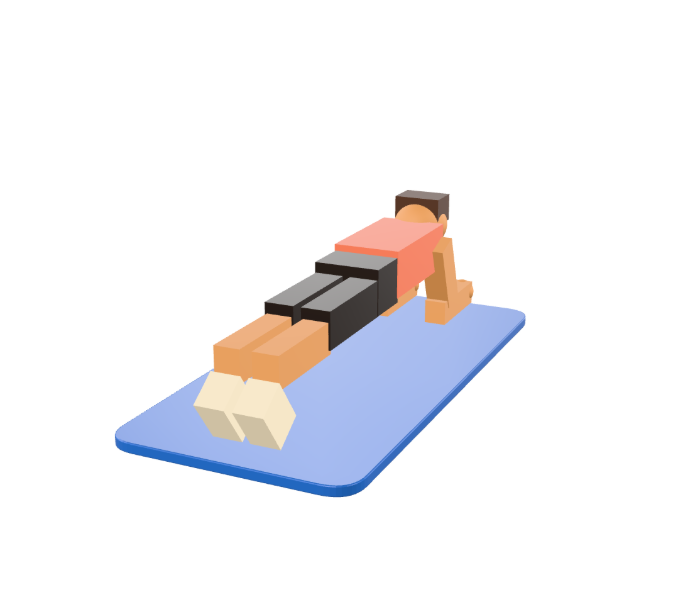
- 10 slow push-ups, or incline push-ups if you need them
- 2 warm-up sets on the first exercise
For a back session, add 10 banded pull-ups or some very light rows. For an arm session, a few empty curls with 2 kg dumbbells will do: biceps and triceps warm up fast and do not need a long protocol.
Which exercises to warm up before a lower body session?
The lower body takes the heaviest loads, so the warm-up that gets you ready has to be more complete. Add five minutes compared with an upper body day.
Start with 5 minutes on the bike, then move on to bodyweight squats, walking lunges and glute bridges. Those three movements wake up the quads, the hamstrings and the glutes, exactly the muscles the squat and the deadlift are about to hit.
Finish with the ramp-up on the main lift. On a squat, plan 3 to 4 warm-up sets: empty bar, then 40%, 60% and 80% of your working weight. Your knees and hips need those intermediate reps to settle into position.
Stretching before or after the session?
Static stretching has no place before a lifting session. Holding a stretch for more than 30 seconds temporarily cuts the force you can produce, by around 5%. You are making yourself weaker right before you load the bar.
Before the session, go with dynamic stretching instead: swings, walking lunges, wide controlled movements. They get the body ready without reducing force output.
Keep static stretching for the end of the session, or for a separate one if you are working on flexibility. A five-minute cool-down is plenty: a few held positions on the areas you hit hardest, without chasing pain.
The mistakes that ruin a warm-up
The first is skipping it because you are short on time. Ten minutes taken out of an hour-long session changes nothing about your training volume, but it changes a lot about the quality of your first three sets.
The second is doing too much. A warm-up that turns into a cardio session of its own leaves you less energy for the weights. Stay at low intensity.
The third is running the same warm-up whatever the session. Shoulder work before leg day does nothing for you. Match the content to the first exercise on the list, and keep the same structure: general, joints, specific. The guided session on your phone means you do not have to think about it every time.