

Dépense estimée selon votre poids
Poids du corps, rythme soutenu · 2 s par répétition
| Répétitions | Dépense estimée |
|---|---|
| 1 | 0,35 kcal |
| 10 | 3,5 kcal |
| 20 | 7,0 kcal |
| 50 | 17,5 kcal |
| 100 | 35,0 kcal |
Estimation à partir des équivalents métaboliques (MET) du Compendium of Physical Activities. La charge, le tempo et la durée des repos font varier le résultat du simple au double : à lire comme un ordre de grandeur, pas comme une mesure.
The plank: what it actually is
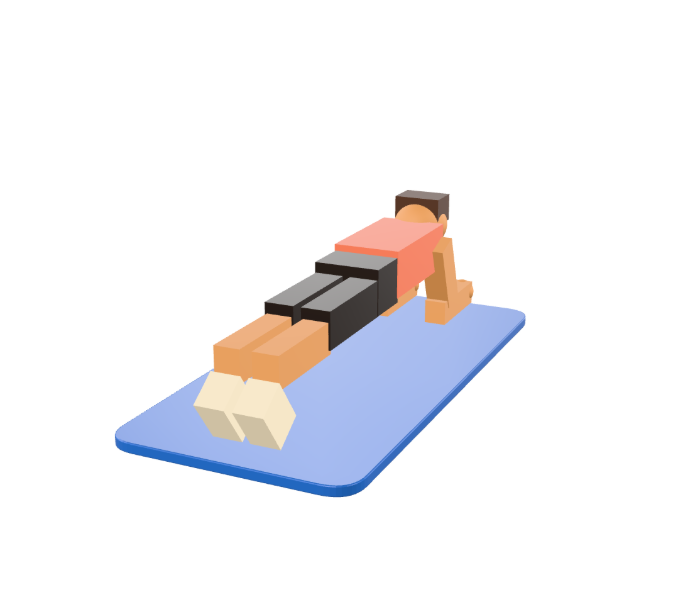
The plank is an isometric exercise: you don't move, you hold. Your body forms a straight line from shoulders to feet, supported on your forearms and toes. No equipment, no weights, just the floor.
On paper (front plank, bodyweight hold), the exercise needs nothing at all. That's why it shows up in almost every strength program, from complete beginners to trained athletes.
The principle fits in one sentence. Gravity pulls your hips toward the floor, and your core resists. That constant tension is what makes the plank useful for stabilising your spine, in daily life as much as in sport.
Plank position: the correct posture, point by point
Most mistakes come from the hips. Too high and the exercise gets easy, working almost nothing. Too low and the load dumps into your lower back.
- Elbows directly under the shoulders, forearms parallel, hands flat or fists closed
- Slight posterior pelvic tilt, glutes squeezed, legs straight
- Feet hip-width apart for a stable base
- Eyes on the floor, neck in line with the spine
- Keep breathing, never hold your breath
Simple check: if you feel it pulling in your lower back, lift your hips a couple of centimetres and draw your navel in. Holding a perfect position for 20 seconds beats two minutes with a broken line.
What does the plank work? The muscles involved
It's the most common question about the exercise, and the answer goes well beyond the abs you can see. The plank recruits the whole trunk as a chain.
The deep trunk muscles
The transverse abdominis and the multifidus fire first. These deep muscles lock the vertebrae in place and protect the lower back. You can't see them, but they're the reason the plank does anything for stability.
The abs and obliques
The rectus abdominis holds the front of the trunk. The obliques kick in as soon as the body tries to rotate, which is especially pronounced in the side plank.
The rest of the body
The shoulders take part of the weight, the arms stabilise the base, the glutes and quads stop the hips from dropping. The spinal erectors balance the forward pull. In other words: what does the plank build? Just about everything connecting your legs to your torso.
In practice, someone who holds 45 seconds without letting the hips sag has a stronger core than someone who holds 3 minutes with an arched back.
How long to hold a plank: useful durations and progression
There's no point chasing extreme hold times. Past two minutes, the strength gain plateaus and the exercise becomes mostly a tolerance test. Better to add sets or move to harder variations.
| Level | Hold per set | Sets |
|---|---|---|
| Beginner | 15 to 20 s | 3 |
| Intermediate | 30 to 45 s | 3 to 4 |
| Advanced | 60 to 90 s | 4 |
| Tabata format | 20 s / 10 s rest | 8 |
Three sessions a week is enough, meaning 5 to 8 minutes of genuinely useful plank work per week. That's not much, provided the position holds up from the first second of each set to the last.
If you'd rather have those hold times adjust themselves week after week, our personalised strength programs build core progression into the schedule instead of leaving it to guesswork.
Variations: side plank, high plank, knees, dynamic
The plank (the most widely practised core exercise in the world) comes in a dozen or so versions. Each one shifts the load onto a different group.
Plank on your knees
The support moves from your feet to your knees, cutting the lever arm by about a third. It's the way in for a beginner, for coming back after a break, or for the end of a session when your form starts to fall apart.
High plank
Also called the straight-arm plank, it's held on your hands with the elbows locked. Shoulders and triceps work harder, while the demand on the abs stays close to the forearm version.
Side plank
Held on one forearm and the edge of your foot, it targets the obliques and the glute medius. It's the most useful variation for improving standing posture and fixing a left-right imbalance.
Dynamic plank
Here you add movement to the hold: elbows to hands and back, shoulder taps, knee drives. The movement raises energy expenditure and breaks the monotony of static sets.
A full sequence runs in four parts: high plank (30 seconds), right side plank, left side plank, then a dynamic version. The video exercise library shows every position from the front and the side, which settles the question of what it should look like.
Plank world records: what the numbers say
The men's plank world record now stands at over 9 hours, set by Czech athlete Josef Šálek in 2023. On the women's side, the mark passed 4 h 30 thanks to Canadian Donna Jean Wilde in 2024.
These are feats of extreme endurance, not everyday training. They're no kind of target to copy: hours of accumulated postural fatigue give you nothing that a well-executed 60-second set doesn't. Treat them as trivia, not as a benchmark.
Plank before and after: what results to expect
The first changes are neural. In two to three weeks, your hold time jumps sharply without the muscle changing much: the body is simply learning to recruit the right support.
Then come the visible effects on posture. You sit more upright, feel less tension in the lower back, transfer force better when running or in contact sports. On the stomach, though, let's be clear: planks don't burn belly fat locally. They strengthen the muscles under the fat layer; definition comes from a calorie deficit.
- Weeks 1 to 3: hold time doubles, posture still shaky
- Weeks 4 to 8: solid position, lower-back pain often easing off
- Past 3 months: noticeably denser midsection
One last practical point: planks and improvisation don't mix. Putting them in a plan, like the rest of the session, stops you skipping them the moment you're short on time. The available plans and pricing all include progress tracking on this kind of exercise.