


Dépense estimée selon votre poids
Mouvement d'isolation · 3 s par répétition
| Répétitions | Dépense estimée |
|---|---|
| 1 | 0,23 kcal |
| 10 | 2,3 kcal |
| 20 | 4,6 kcal |
| 50 | 11,5 kcal |
| 100 | 23,0 kcal |
Estimation à partir des équivalents métaboliques (MET) du Compendium of Physical Activities. La charge, le tempo et la durée des repos font varier le résultat du simple au double : à lire comme un ordre de grandeur, pas comme une mesure.
The dumbbell shrug in one sentence
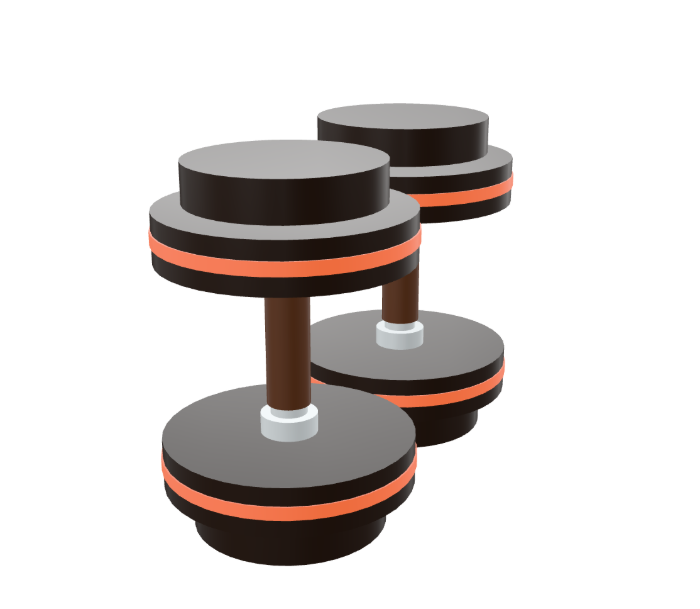
The dumbbell shrug is an isolation exercise. You hold a dumbbell in each hand, arms straight at your sides, then lift your shoulders straight up. Nothing else moves.
One muscle group, the traps, takes the whole load. It's the most direct way to build thickness in the upper back. You do it standing, at the gym or at home, with nothing but a pair of dumbbells.
The name says it all: to shrug is to raise your shoulders. The everyday gesture is already the exercise. You just add weight to it.
Which muscles does it work?
The upper traps do most of the work. They're what elevates the shoulder blade when the load pulls down.
- Upper traps: prime mover of the shrug.
- Mid traps: brought in as soon as you squeeze the shoulder blades together at the top.
- Levator scapulae and rhomboids: stabilisers of the movement.
- Forearms and grip: your hands usually give out before the target muscle does.
The delts barely contribute. Contrary to a common belief, shrugs don't build the shoulders themselves: they thicken the trap that connects them to the neck. For more complete upper-body work, pair it with rows and a press such as the incline dumbbell press.
In the gym, the real limit on dumbbell shrugs is almost never the trap. It's your grip letting go on the eighth rep.
How to do dumbbell shrugs
Starting position
Stand with your feet shoulder-width apart, knees slightly unlocked. A dumbbell in each hand, neutral grip, palms facing your thighs.
Arms straight at your sides, back flat, eyes forward. Keep your shoulders back and your chest open: that posture protects the neck and puts the trap in a strong position.
Executing the movement
Lift your shoulders up, as high as you can, as if to touch your ears. Hold the peak contraction for 1 to 2 seconds. Lower slowly, over 2 to 3 seconds, until you feel the stretch at the bottom.
The whole cue comes down to one thing: your shoulders are the only part that moves. Your arms are hooks, not levers. If your elbows bend, the weight is too heavy.
Breathe in on the way up, out on the way down. Count on 12 to 15 reps per set for this kind of short-range exercise.
Dumbbells or barbell?
Both work. They just don't put the same constraints on you.
| Criterion | Dumbbells | Barbell |
|---|---|---|
| Range of motion | Larger | Limited |
| Max load | Moderate | High |
| Arm position | At the sides | In front |
| Wrist comfort | Good | Average |
| Equipment needed | 2 dumbbells | Bar + plates |
With dumbbells, your arms stay at your sides: the range of motion is freer and the neutral grip is easier on the wrists. With a barbell held in front of your thighs, you can load heavier but the bar itself blocks the top of the movement.
Dumbbell shrug variations
Seated dumbbell shrug
Sit on the end of a bench, back flat, dumbbells at your sides. Your legs can't cheat any more. It's the strictest version, ideal if you catch yourself pushing off your feet.
Incline or bent-over dumbbell shrug
Chest against a bench set at 30 or 45 degrees, arms hanging. This version shifts the work towards the mid traps and the rear delts. It calls for much lighter weights.
Wide grip and heavy loads
Heavy shrugs are still an option, but with straps: without them, your hands decide when the set ends. Hold the same standard of posture, whatever the weight.
Mistakes to avoid
- Rolling your shoulders in circles: no muscle gain, real wear on the joints.
- Bending your elbows and turning the shrug into a botched upright row.
- Going too heavy and losing two thirds of the range of motion.
- Sinking your head into your shoulders instead of lifting them.
- Rattling off reps with no pause at the top.
How many sets, and where to put the exercise
The shrug is an isolation movement: it belongs at the end of a back or shoulder session. Count on 3 to 4 sets of 12 to 15 reps, with 60 to 90 seconds of rest. Twice a week is enough to make progress on this muscle.
Progress comes from the load, but also from how long you hold the contraction. Going from 1 to 3 seconds at the top changes a set without touching the dumbbells.
Knowing how to dose these variations session after session is the real work. MUSCU builds that plan from your profile, films every exercise and tracks your loads week to week: all you have to do is train. See how a tailored strength training programme lays out these sets.