

Dépense estimée selon votre poids
Mouvement d'isolation · 3 s par répétition
| Répétitions | Dépense estimée |
|---|---|
| 1 | 0,23 kcal |
| 10 | 2,3 kcal |
| 20 | 4,6 kcal |
| 50 | 11,5 kcal |
| 100 | 23,0 kcal |
Estimation à partir des équivalents métaboliques (MET) du Compendium of Physical Activities. La charge, le tempo et la durée des repos font varier le résultat du simple au double : à lire comme un ordre de grandeur, pas comme une mesure.
The dumbbell bench press, a staple chest exercise
The dumbbell bench press means pressing two free weights from your chest to full arm extension while lying on a bench. It's the free-weight version of the bench press, the number one chest builder in the gym.
What separates it from the barbell version is one small detail that changes everything: each hand carries its own load. Both sides work independently, with no way for one arm to cover for the other.
The result: more range of motion than with a barbell, and far more work for the stabilising muscles around the shoulder. It's a complete chest exercise, not a fallback option.
Which muscles does it work?
Three muscle groups drive the movement. The pec major supplies most of the force, mainly through its sternal portion.
- Chest: prime mover, across the whole range
- Triceps: dominant at the top of the press, as the elbows extend
- Front delts: active from the bottom of the descent onwards
- Rotator cuff and lats: keeping the shoulder and torso stable
So chest, triceps and shoulders work together. On the last few reps, it's usually the triceps that give out first.
In the gym, someone switching from barbell to dumbbells drops 15 to 20% of their working weight on the first session. That's not going backwards: it's what stabilising costs you.
How to do it: setup, range, breathing
Sit at the end of the bench with the dumbbells resting on your thighs. Rock back while driving with your knees to bring the weights into the top position. Getting into place is the riskiest part when the weights are heavy.
Once you're lying down, plant your feet on the floor, squeeze your shoulder blades together and keep a slight arch in your lower back. Your elbows stay at around 45 degrees from your torso, never flared out to 90.
Lower slowly until the dumbbells reach chest level, then press the dumbbells back up without banging them together. Breathe in on the way down, out on the way up.
On a flat bench
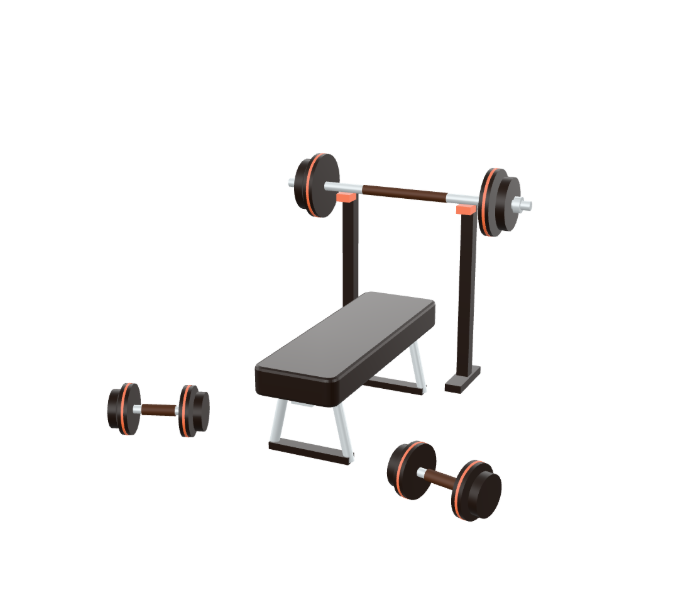
The flat-bench dumbbell press is still the benchmark. The bench needs to be stable and wide enough to support your back without pinning your shoulder blades. Plan on bringing the dumbbells back down to your thighs at the end of the set rather than dropping them.
On the floor
The dumbbell floor press cuts the descent short: your arms hit the floor before you reach full range. That limit is useful when your shoulder is cranky, and it's your only option if you don't have a bench. The initial push is harder here, with no elastic bounce to help.
Incline and neutral grip
At 30 degrees, the incline dumbbell press shifts the work towards the upper chest. Past 45 degrees, the shoulder takes over and the payoff drops off.
A neutral grip, palms facing each other, cuts down external rotation at the shoulder. It brings the triceps in more and suits anyone who feels joint discomfort. You'll find all these variations on video in the MUSCU exercise library.
How much weight should you use?
The right weight is the one that lets you control a 3-second descent. If the dumbbell drops, it's too heavy.
A rough guide: someone pressing 60 kg on the barbell usually handles around 2 x 22 kg with dumbbells. Dumbbell pressing 40 kg per arm puts you at an advanced level, after two or three years of consistent training.
| Level | Weight per hand | Reps |
|---|---|---|
| Beginner | 8 to 12 kg | 12 |
| Intermediate | 16 to 24 kg | 10 |
| Advanced | 30 to 40 kg | 6 to 8 |
Only add 2 kg per hand once your last rep still looks clean. A written progression plan keeps you off six-month plateaus: structured training programmes handle those weight jumps for you.
Dumbbells, barbell, machine or push-ups
Dumbbell bench press or barbell? The question never goes away. The barbell lets you handle heavier loads and gives you a number to chase; dumbbells give you range of motion and even work on both sides.
Against the machine, the gap is obvious: the machine guides the path, so it feels safe but takes the stabilising work away. Choosing to use dumbbells means trading a bit of weight for more control.
As for push-ups, they're still an excellent bodyweight exercise, but progress stalls quickly. Pick up dumbbells and working long sets becomes far more precise straight away.
Mistakes to avoid
- Flaring your elbows out to 90 degrees: the number one cause of shoulder injuries
- Dropping too fast and bouncing off your chest
- Lifting your feet or your back off the bench
- Slamming your elbows into a hard lockout on every rep
It's important to keep your neck neutral and your eyes on the ceiling. Stay braced through your torso from the first rep to the last: clean execution beats one extra kilo.