


Dépense estimée selon votre poids
Mouvement d'isolation · 3 s par répétition
| Répétitions | Dépense estimée |
|---|---|
| 1 | 0,23 kcal |
| 10 | 2,3 kcal |
| 20 | 4,6 kcal |
| 50 | 11,5 kcal |
| 100 | 23,0 kcal |
Estimation à partir des équivalents métaboliques (MET) du Compendium of Physical Activities. La charge, le tempo et la durée des repos font varier le résultat du simple au double : à lire comme un ordre de grandeur, pas comme une mesure.
Shrugs: what they are and which muscles they work
To shrug simply means raising your shoulders. The word already describes the movement: you lift your shoulders up, hold for a beat, then lower them. Nothing else moves.
So the shrug is an isolation exercise, done standing, arms hanging straight down, with dumbbells, a barbell or a machine. And it's one of the best ways to build the upper back without any complicated equipment.
Only a handful of muscles are involved, but they're worked hard:
- Upper traps: the main engine of the movement.
- Levator scapulae, underneath the trap, working from the very first inch.
- Rhomboids, especially if you squeeze your shoulder blades together at the top.
- Forearms and grip: your hands often give out before your traps do.
Why bother with shrugs?
Strong traps stabilise the shoulder girdle. In practice, that means holding onto a heavy bar in the deadlift and better posture when you spend the day sitting down (which is almost everyone). Your shoulders and back stay less rounded forward.
Dumbbell shrugs: the most common version
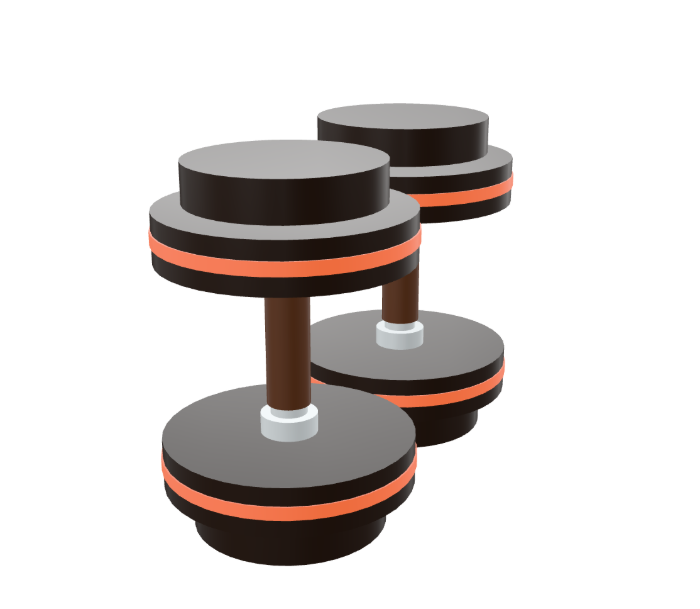
This is by far the most searched version of the exercise, and for good reason: dumbbells are everywhere and the starting position takes two seconds to set up.
Stand tall, feet about shoulder-width apart, a dumbbell in each hand, palms facing back or facing in. Keep your back straight, chest open, eyes forward. Your straight arms do no work at all: they're just hooks.
Breathe in, then lift your shoulders up as high as you can, like you're trying to touch your ears. Hold for 1 second at the top, then lower slowly under control over 2 to 3 seconds. Slowly, and I mean it.
On this exercise, most lifters go too heavy and give up half the range of motion. A lighter load taken all the way up creates more tension than a maximal weight that barely moves.
Run 3 to 4 sets of 12 to 20 reps, with 60 to 90 seconds of rest. If your grip fails before your traps, use straps once you're past 30 kg per hand. The video entries in our filmed exercise library show the tempo to hold on every rep.
Barbell shrugs, machine shrugs and Kelso shrugs
Barbell shrugs
A barbell lets you load more weight, often 20 to 30% more than with two dumbbells. Hold it in front of your thighs, overhand grip, hands shoulder-width apart. The downside? The bar rubs against your body and cuts the range of motion slightly at the bottom. Holding the bar behind your back fixes that and hits the traps from a different angle.
Machine and cable shrugs
On a machine or a low cable, the resistance stays constant from bottom to top. That's handy at the end of a session, when fatigue makes your posture less steady. The path is guided, so it's harder to let technique slip.
Kelso shrugs
Less well known, Kelso shrugs are done bent over or lying face down on an incline bench, arms hanging towards the floor. You retract your shoulder blades without bending your arms. That shifts the work to the mid and lower traps, exactly the ones most lifters are missing. That's where the real difference gets made.
Dumbbell or barbell shrugs: which one?
The question comes up every back day. Here are the differences that actually matter in the gym.
| Criteria | Dumbbells | Barbell |
|---|---|---|
| Range of motion | Full | Cut short at the bottom |
| Max load | Moderate | High |
| One side at a time | Yes | No |
| Technical demand | Low | Moderate |
| Grip as limiter | Often | Rarely |
My take, in practice: dumbbells for range of motion and for fixing side-to-side imbalances, barbell for going heavy. Alternating the two in 6-week blocks is the simplest way to handle it. And if you're not sure where those blocks fit in your week, MUSCU builds the schedule around your profile and the equipment you have.
Mistakes to avoid
- Rolling your shoulders backwards: no extra muscle, just needless stress on the joint.
- Bending your arms and pulling with the biceps, which takes the point out of the exercise.
- Pushing your head forward instead of keeping your neck in line.
- Cutting the movement short at the top: without a hard squeeze, the traps barely work.
Fitting shrugs into your session
Put shrugs at the end of a back or shoulder session, after your pulldowns and rows. Two sessions a week are enough to make progress on a muscle group this small.
Pair them with barbell rows, lat pulldowns and deadlifts. The shrugs vs farmer's walk debate comes up a lot: the farmer's walk works the traps isometrically and loads the whole body, while the shrug builds size through the movement itself. They complement each other rather than compete! Our goal-based training programmes already balance the two.
To keep progressing, add 1 to 2 kg per hand every two weeks, or one rep per set. Write your loads down. Without tracking, progress on this kind of exercise goes completely unnoticed.