


Dépense estimée selon votre poids
Mouvement d'isolation · 3 s par répétition
| Répétitions | Dépense estimée |
|---|---|
| 1 | 0,23 kcal |
| 10 | 2,3 kcal |
| 20 | 4,6 kcal |
| 50 | 11,5 kcal |
| 100 | 23,0 kcal |
Estimation à partir des équivalents métaboliques (MET) du Compendium of Physical Activities. La charge, le tempo et la durée des repos font varier le résultat du simple au double : à lire comme un ordre de grandeur, pas comme une mesure.
Dumbbell hammer curls: what we're talking about
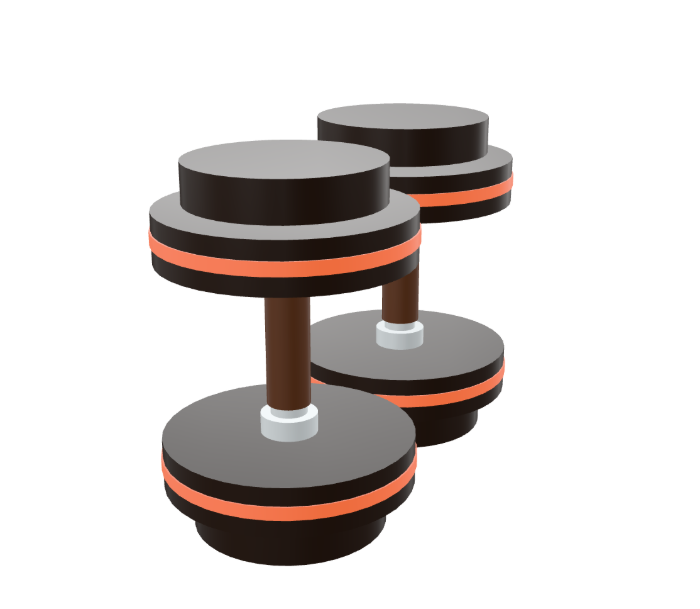
The dumbbell hammer curl is an elbow flexion done with a hammer grip. Palms face each other, thumbs up, and the hand never rotates from start to finish. You'll also see it called a neutral grip.
That's the only difference with a standard curl. It's enough to shift part of the work onto the forearm. The dumbbell hammer curl is still an isolation exercise, easy to learn (genuinely easy), but hard to hold clean once you hit the twelfth rep and the shoulder starts wanting to help.
The muscles worked
Three muscles split the load, in a different order than a supinated curl.
- Brachialis: sitting underneath the biceps, it pushes the biceps up as it thickens.
- Brachioradialis: the visible ridge on the forearm, heavily loaded with a neutral grip.
- Biceps brachii: still active, but in a less favourable position than palms-up.
Throughout the set, the finger flexors work isometrically without ever letting go. Hence something you've probably already noticed on heavy loads: the grip gives out before the arms do.
The technique, position by position
Starting position
Standing, feet hip-width apart, a dumbbell in each hand. Arms hang alongside the body, elbows unlocked. One cue sums it up: stand tall and keep the arms at the sides.
Brace the torso, keep the shoulder blades down. Elbow position is the critical point: they stay in contact with the ribs.
The way up
Bend the elbow and bring the dumbbell towards the shoulder, palms facing each other, without ever turning the wrist. The movement stops when the forearm reaches chest height.
Count one second on the way up. Going higher achieves nothing: past that point the shoulder takes over and the tension leaves the arm.
The way down
Lower over 2 to 3 seconds, under control. On this kind of curl, the eccentric phase does a big share of the work.
Come all the way back down every rep, arms straight. Cut the last few centimetres of range and the brachioradialis drops out almost immediately.
In the gym, half the lifters let their elbows drift forward by the sixth rep. The movement turns into a torso swing, and the forearm stops working.
Dumbbells or the cable rope
The question comes up constantly: dumbbell hammer curls or the rope on the cable? Both work. Just not at the same point in the session.
| Criterion | Dumbbells | Cable rope |
|---|---|---|
| Tension at the bottom | Low | Constant |
| Maximum load | High | Moderate |
| Unilateral work | Yes | Limited |
| Equipment | 2 dumbbells | Low pulley |
| Spot in the session | Start | End |
In practice: dumbbells to load, the rope to finish. And if your window is 45 minutes, keep the dumbbells and skip the cable.
Variations worth your time
- Seated: back against the bench, no cheating with the hips.
- Cross-body: the dumbbell travels towards the opposite shoulder, hits the brachialis hard.
- Incline: bench at 45 degrees, a stronger stretch at the bottom.
- Alternating: one hand after the other, often 2 to 3 kg more per arm.
Rotate these versions every four to six weeks, never within the same session. Our ready-to-follow training programmes build these rotations in so you don't have to plan them.
Sets, loads and progression
Three to four sets of 8 to 12 reps, twice a week, covers what most lifters need. Put the exercise after back work or at the end of an arm session. Never first.
Load reference: an intermediate lifter at 75 kg often works between 12 and 16 kg per hand for 10 clean reps. That's a ballpark, not a target to chase.
The progression rule is simple: add 1 kg once you hit 12 strict reps two sessions in a row. Which means writing your loads down, otherwise progress stalls for weeks without anyone noticing. Automatic load tracking settles that in three seconds per set.
The most common mistakes
- Swinging the torso to throw the dumbbell up.
- Letting the wrist fall back instead of keeping it aligned.
- Letting the elbows come forward at the end of the set.
- Stopping halfway down, because the load is too heavy.
Two of these in the same set? Take 2 kg off. A clean hammer curl at 12 kg builds more arm than a sloppy one at 18 kg.