

Dépense estimée selon votre poids
Mouvement d'isolation · 3 s par répétition
| Répétitions | Dépense estimée |
|---|---|
| 1 | 0,23 kcal |
| 10 | 2,3 kcal |
| 20 | 4,6 kcal |
| 50 | 11,5 kcal |
| 100 | 23,0 kcal |
Estimation à partir des équivalents métaboliques (MET) du Compendium of Physical Activities. La charge, le tempo et la durée des repos font varier le résultat du simple au double : à lire comme un ordre de grandeur, pas comme une mesure.
Incline curl: what the position changes for your biceps
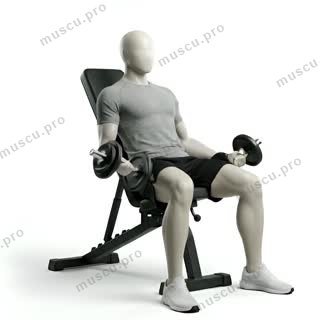
Sitting on an incline bench, back flat against the pad, arms hanging straight down: that's the incline curl. This position pulls your elbows behind the line of your body. So the long head of the biceps starts out already stretched, before the first rep even begins.
That's the whole difference with the standing curl. Arms at your sides, the long head works in a shortened position and tension drops off at the bottom. Here, tension peaks right from the bottom of the movement, over the range where the muscle does the most useful damage.
Three muscles are involved: the biceps brachii with its two heads, the brachialis, and the brachioradialis. With dumbbells, the exercise clearly biases the long head, the one that gives you the visible peak.
In practice, most lifters drop 20 to 30% of their load when they switch from the standing curl to the incline curl. That's not a step backwards: that's the cheating disappearing.
How to do the incline dumbbell curl
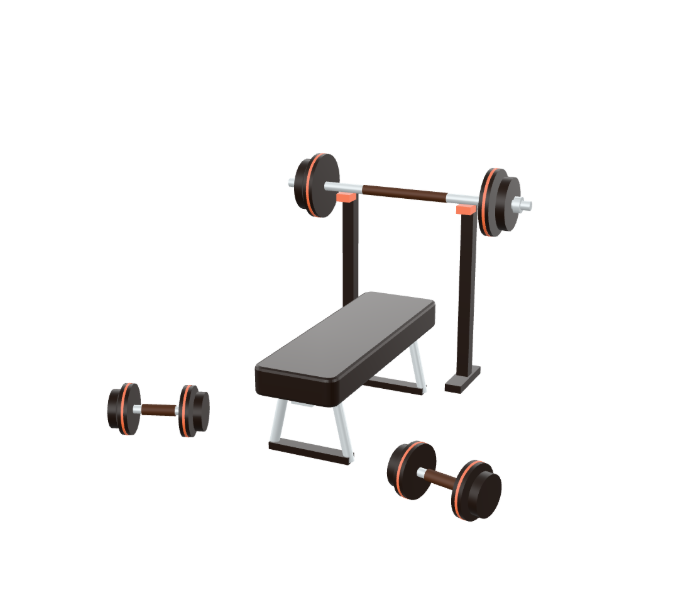
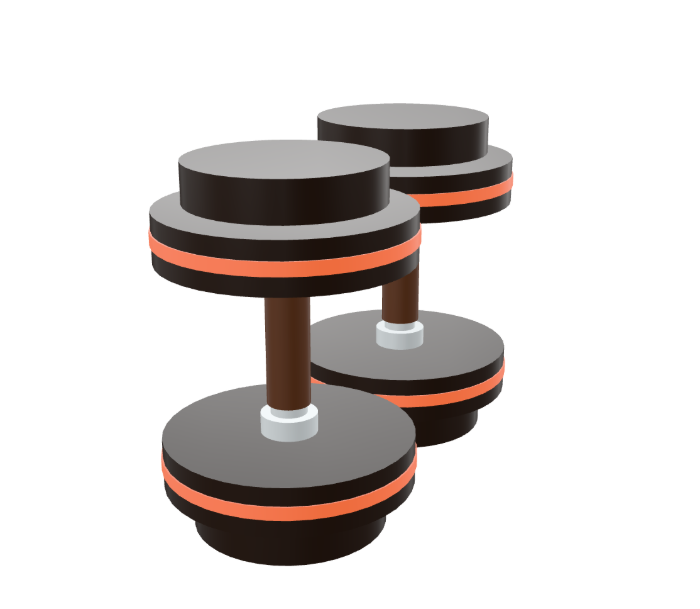
We'll use an adjustable bench and two dumbbells here. The movement is simple, but it doesn't forgive sloppiness.
The starting position
- Set the bench angle, sit down, back and head in contact with the pad.
- Let your arms hang fully extended, palms facing forward in supination.
- Squeeze your shoulder blades: the shoulder stays down and back, never rolled forward.
- Your elbows should stay fixed, slightly behind your torso.
Feeling too much stretch in the tendon at the start? Raise the backrest. The sensation should come from the muscle, not from the shoulder tendons.
The way up and the way down
Curl the weight up while keeping the elbow still. Only the forearm moves. At the top, pause to squeeze the biceps without pulling the elbow toward your torso, or the tension escapes.
The lowering counts just as much (and that's where everything happens). Control it over 2 to 3 seconds until the arm is fully extended. It's during this eccentric phase, in the stretched position, that the movement pulls ahead of a standard arm program.
Which bench angle should you use?
The angle decides everything. The lower the backrest, the bigger the stretch, and the more strain on the shoulder.
| Angle | Stretch | Who it's for |
|---|---|---|
| 75 degrees | Low | Beginner |
| 60 degrees | Decent | Sensitive shoulders |
| 45 degrees | High | Go-to setting |
| 30 degrees | Very high | Advanced only |
Two weeks at 60 degrees, then drop to 45: that's the path I'd recommend. Below that, the arm travels far back and the joint risk outweighs the muscle gain.
Incline curl variations
The basic movement has several versions depending on what your gym has.
Hammer grip and rotation
With a hammer grip, palms facing each other, you load the brachialis and brachioradialis more. Add rotation and you start neutral at the bottom and finish in supination: the final biceps contraction is sharper. This fixed-elbow principle applies to the hammer curl and the incline curl in exactly the same way.
Incline curl on a cable or machine
On a low pulley, tension stays constant through the whole range, including at the top. Set the bench about a meter from the pulley. The machine incline curl, available in most chain gyms, locks in the path: handy when fatigue sets in late in the session.
One arm or both
Arm by arm, you fix imbalances and get a full range of motion. Both arms at once is twice as fast. Alternate depending on how much time you have.
Incline curl or preacher curl: which one?
The question comes up a lot, and the answer comes down to muscle length. Two staple biceps exercises: the incline curl and the preacher curl work different parts of the strength curve.
- Incline curl: elbows back, long head stretched, heavy resistance at the bottom.
- Preacher curl: elbows forward, short head favored, heavy resistance at the top.
They don't compete, they complement each other. Only room for one? Take the incline curl: recent research on training in the stretched position favors movements loaded at long muscle lengths. If your session has two isolation exercises, do both.
The mistakes that ruin the movement
The most common one: letting the elbows drift forward on the way up. The movement turns into a seated standing curl and the whole point is gone. The second: peeling your back off the bench to throw the weight up with your body.
Then come the shoulder rolling forward, cutting the range short at the bottom, and going too heavy. There's one cause behind all of it: the wrong weight. Drop 4 kg and the movement fixes itself.
A catalog of 1,800 filmed exercises and a guided session on your phone keep this from happening, because you see the exact angle before you load up. The tracking features also log your load set by set.
Where to put it in your session
The incline curl is an isolation exercise. It comes after pulldowns and rows, never before. Plan on 3 to 4 sets of 8 to 12 reps, with 90 seconds of rest.
Two arm sessions a week is enough to make progress. Put the dumbbell version in the first one, the cable or machine version in the second: varying the angle and the tension keeps progress going without making your workouts longer.