
Dépense estimée selon votre poids
Mouvement d'isolation · 3 s par répétition
| Répétitions | Dépense estimée |
|---|---|
| 1 | 0,23 kcal |
| 10 | 2,3 kcal |
| 20 | 4,6 kcal |
| 50 | 11,5 kcal |
| 100 | 23,0 kcal |
Estimation à partir des équivalents métaboliques (MET) du Compendium of Physical Activities. La charge, le tempo et la durée des repos font varier le résultat du simple au double : à lire comme un ordre de grandeur, pas comme une mesure.
The spider curl, a strict curl with your chest on the bench
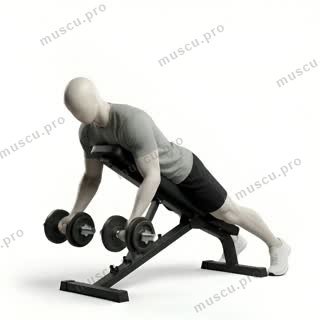
The spider curl is done chest down on an incline bench, arms hanging free, perpendicular to the floor. This position kills any swing from the hips and back. The result: the biceps works alone, with no way to cheat.
We'll set the bench between 45 and 60 degrees here. You lie face down against the pad, feet on the floor, shoulders off the support. Your arms hang straight down.
This is an isolation exercise, not a strength movement. You load it light and chase tension, not a personal best.
How to do the spider curl properly
The starting position
- Bench inclined, chest resting on it, chin just over the top edge
- Arms hanging vertically, supinated grip (palms facing up)
- Elbows slightly bent, never locked out
- Shoulders down, abs tight, eyes forward
Performing the movement
Curl the bar up toward your shoulders while keeping your elbows fixed. Only the forearm moves. Hold for a second at the top, then lower over 3 seconds.
Control the lowering phase of the movement so you don't drop the weight all at once. On this kind of curl, the eccentric phase is what drives most of the muscle growth.
Keep your chest against the pad from start to finish. If you have to peel your chest off to finish the set, the weight is too heavy.
On the spider curl, most lifters feel it far more as soon as they drop 20 to 30% off the weight they were using on standing curls.
Spider curl: which muscles are working
The biceps brachii is the main muscle. The brachialis and brachioradialis also get worked, especially at the end of the range.
With the arms out in front of the body, the long head of the biceps is in a shortened position. So it works less than on the incline bench curl, where the arms start behind the torso. The two exercises complement each other, they're not interchangeable.
EZ bar vs dumbbell curl: which to pick
The EZ bar forces a semi-supinated grip that's easier on the wrists. Dumbbells let you supinate progressively and fix imbalances between your right and left arm.
| Criteria | EZ bar | Dumbbells |
|---|---|---|
| Wrist comfort | High | Medium |
| Full supination | No | Yes |
| Fixes asymmetry | No | Yes |
| Max load | Heavier | Lighter |
| Stability | Good | Takes practice |
A straight bar still works, but it pulls on the wrists for a lot of lifters. Start with the EZ bar, move to dumbbells once your technique is clean.
Spider curl or preacher curl
The preacher curl (Larry Scott curl) rests your arms on an angled pad: tension drops off at the top of the movement. The spider curl keeps strong resistance through the whole way up.
In practice: the preacher is harder at the bottom, the spider is harder at the top. Alternating the two over a 6-week cycle covers both ends of the range.
Common mistakes to fix
- Letting the elbows drift forward on the way up: the delts take over
- Peeling your chest off the bench to force out the last rep
- Partial range, stopping halfway
- Bench set too upright, which crushes your ribcage and makes breathing hard
A mirror to the side or a video from profile is enough to check the bar path. For this kind of detail, execution videos beat any written description.
Where the spider curl fits in your program
Put it at the end of your arm session, after a heavy curl. Plan on 3 to 4 sets of 10 to 15 reps, with 60 to 90 seconds of rest. The point is time under tension, not the load.
On a 4-session training program, one biceps session per week is enough for most intermediate lifters. Two sessions a week start to pay off after about two years of consistent training.
To build your arms effectively, what matters most is making sure progression is measured: weights logged, reps logged, week after week. Without tracking data, you go in circles for months.
MUSCU builds personalized plans from your profile, with sets matched to your level and video content covering 1,800 filmed exercises so you can check every position. Load tracking carries over automatically from one session to the next.
You can also look at the details of the session tracking tools before building your cycle. For the sake of progress, an 8-week cycle is the minimum before you judge an exercise.